Heat pumps come up in more and more of our conversations with Westminster homeowners. People hear about them from neighbors, see them listed on replacement estimates, and read about them in energy news. The questions we get tend to sound the same. What is a heat pump, exactly? How can one system heat and cool a house? And will it hold up when Front Range winters turn bitter?
Those are fair questions, and the answers depend a lot on the equipment. At its core, a heat pump is an electric heating and cooling system that moves heat between the inside and outside of your home rather than burning fuel to make it. In a mild climate, most heat pumps handle that job well. Here, where overnight lows can drop into the single digits, the details matter more. This guide walks through how a heat pump works, the main types, what sets cold climate heat pumps apart, and how a heat pump compares to a gas furnace, so you can decide whether one makes sense for your home.
Key Takeaways
A heat pump heats and cools your home by moving heat between the indoors and the outdoors.
Outdoor air still holds heat energy in cold weather, and a heat pump is built to extract it.
Air source heat pumps are the most common type. Ductless mini splits work well for homes without ducts or for rooms that never feel right.
Standard heat pumps lose heating output as temperatures drop. Cold climate heat pumps are designed to keep heating in much colder conditions, which is why we recommend them for most Colorado homes.
Many Front Range homes pair a heat pump with a gas furnace in a dual fuel system for the coldest nights.
The right setup depends on your home, your existing ductwork, and your comfort goals. Efficient Comfort installs Bryant systems and repairs and maintains all makes and models.
What Does a Heat Pump Do?
A heat pump does the job of two systems. In cooling mode, it works like a central air unit, pulling heat out of the air inside your home and releasing it outdoors. In heating mode, it runs in the opposite direction, collecting heat from the outdoor air and bringing it inside.
The important word there is move. A gas furnace has to generate heat by burning fuel. A heat pump just relocates heat that already exists, and that takes less energy. It’s a big part of why heat pumps are considered so energy efficient.
Which usually brings up the next question. What heat is there to collect when it’s 20 degrees outside?
More than you’d expect. Cold air still carries thermal energy. As long as the refrigerant inside the heat pump is colder than the outside air, heat flows into it on its own. It’s the same reason a glass of ice water slowly warms up on your kitchen counter.
How Does a Heat Pump Work?
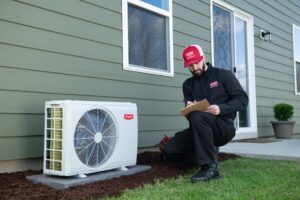
Every heat pump system runs on a closed loop of refrigerant that travels between two main pieces of equipment. Outside, there’s the outdoor unit, which holds the compressor, an outdoor coil, and a fan. Inside, there’s an indoor unit, usually an air handler or furnace with an indoor coil and a blower. Copper refrigerant lines connect the two. A reversing valve decides which way the refrigerant flows, and your thermostat tells the whole system when to run.
Heating Mode, Step by Step
Here’s what happens on a cold morning when your thermostat calls for heat:
Liquid refrigerant at lower pressure runs through the outdoor coil. Because it’s colder than the ambient air, it absorbs heat and turns into a vapor.
The compressor squeezes that vapor, using electrical energy to raise its temperature well above your indoor temperature.
The hot refrigerant travels inside to the indoor coil.
Your blower pushes indoor air across the warm coil and sends heated air through your ductwork.
Having given up its heat, the refrigerant passes through an expansion valve, drops back to a lower pressure, cools off, and heads outside to start again.
It’s the same refrigeration cycle your refrigerator and air conditioners use. The temperature difference between the refrigerant and the air around it is what lets the system transfer heat in either direction.
Cooling Mode
In summer, the reversing valve sends refrigerant the opposite way. Now the indoor coil pulls heat out of your home, and the outdoor unit releases it outside. Cooled air flows back through your vents, and the coil pulls some moisture out of the air along the way, which helps with humidity control on the stickier summer days.
The Defrost Cycle
Every winter, a few new heat pump owners call us after spotting steam rising off the outdoor unit on a frosty morning. Nine times out of ten, that’s the defrost cycle doing its job. When frost builds on the outdoor coil, the system briefly reverses to warm the coil and melt it off, then goes right back to heating. Ice that keeps building and never clears is a different story, and that one is worth a service call.
Types of Heat Pumps
Most heat pumps follow the same basic process. What changes is where they pull heat from and how they deliver it to your rooms.
Air Source Heat Pumps
Air source heat pumps are the most common type, and they’re what most people picture when they hear “heat pump.” They extract heat from the outside air and deliver it through your existing ductwork. In a lot of Westminster homes, an air source heat pump can replace the air conditioner and take over most of the work the furnace used to do.
Ductless Mini Split Systems
A ductless system connects an outdoor unit to one or more wall-mounted indoor units. Each one handles its own room or zone, so you get targeted temperature control. Ductless mini splits make a lot of sense for additions, finished basements, older homes without ductwork, and that bedroom over the garage that’s always ten degrees off.
Geothermal and Water Source Heat Pumps
A geothermal heat pump, also called a ground source heat pump, uses buried loops to tap into the steady temperature underground. Ground source heat pumps are generally the most energy efficient type, but the drilling or excavation makes them a much bigger project. Water source heat pumps work on a similar idea, pulling heat from a nearby body of water. Neither is very common in residential heating along the Front Range.
You may also come across heat pump water heaters, which use the same process to heat water instead of air.
Heat Pumps in Cold Climates: Why Colorado Needs the Right Equipment
Heat pumps earned their reputation in moderate climates, where winters rarely dip far below freezing. Colorado asks a lot more of them. As outdoor temperatures fall, there’s less heat in the air to collect, so a standard heat pump puts out less heat right when your house is losing it fastest.
To make up the difference, many systems switch on electric heat strips. They work, but they’re one of the more expensive ways to heat a home, and your energy bills will reflect it. We meet plenty of homeowners whose standard heat pump ran beautifully in October, then leaned on backup heat almost constantly the first time a cold front pushed Broomfield or Westminster into the single digits.
What Makes a Cold Climate Heat Pump Different
A cold climate heat pump is built to keep producing heat in much harsher conditions. Most use a variable-speed compressor that ramps up when the weather turns and slows down during mild stretches. That supports efficient operation and keeps indoor temperatures steadier. More precise refrigerant controls let the liquid refrigerant keep absorbing thermal energy from the outside air even when it feels bitterly cold.
Bryant’s Evolution Extreme Variable-Speed Cold Climate Heat Pump is a good example. Bryant designed it around the Department of Energy’s Cold Climate Heat Pump Challenge and rates it to keep 100% of its heating capacity down to 5°F. Cold climate heat pumps keep running below that point, but output gradually tapers, so a backup heat plan still matters here.
Why We Start Front Range Homeowners With Cold Climate Models
For most Colorado homes, we treat a cold climate heat pump as the starting point for the conversation, not an add-on. It keeps the heat pump doing more of the work for more of the winter, so backup heat runs less often. That can help keep energy costs in check, and the house stays more comfortable once the real cold weather shows up.
Backup Heat and Dual Fuel Systems
Even a strong cold climate heat pump needs a plan for the coldest nights of the year. There are two common approaches.
The simpler one is electric heat strips inside the air handler, which switch on when the heat pump needs help. The other is a dual fuel system, which pairs the heat pump with a gas furnace. Bryant calls its version Hybrid Heat. The thermostat keeps an eye on outdoor temperatures and hands things over to natural gas when the furnace becomes the more practical heat source.
Plenty of homes in Westminster, Arvada, and Broomfield already have gas service and a furnace with years left in it. For those homes, a dual fuel system can add heat pump efficiency without giving up the dependability of gas heat on a below-zero night.
Heat Pump vs Furnace: How Do They Compare?
This question comes up in nearly every replacement visit we make. Start with efficiency. A traditional gas furnace makes heat by burning fuel, and today’s high efficiency products top out around 98%, meaning nearly all the fuel becomes usable heat. A heat pump doesn’t burn anything. Because it moves heat instead, it can deliver several units of heat for every unit of electricity it uses, which is where you’ll see efficiency figures of 300% to 500% depending on the type of heat pump and the conditions. That number drops as it gets colder outside, which is one more reason equipment choice matters in Colorado.
A few other differences worth knowing:
Heating and cooling: A furnace only heats and needs a separate air conditioner. A heat pump handles both.
How the heat feels: A furnace pushes out hot air in shorter bursts. A heat pump delivers warm air that feels gentler at the vent, with longer, steadier cycles. It surprises some people at first, so it helps to know ahead of time.
Cold weather output: A furnace puts out the same heat at 0°F as it does at 40°F. A heat pump’s output depends on the outdoor temperature and the equipment.
Monthly costs: Operating costs depend on local gas and electric rates, your insulation, and how the system is set up. Neither option comes out ahead in every home.
Upfront cost: Heat pump installation often costs more than replacing a furnace alone, though it also takes the place of your air conditioner.
Carbon footprint: A heat pump doesn’t burn fuel in your home, and its emissions depend on how clean the electricity powering it is.
Heat pumps have also gone fully mainstream. In 2022, more heat pumps were sold in the U.S. than gas furnaces.
A heat pump may be a strong fit if your air conditioner is also near the end of its life, you’d like to use less natural gas, or your home doesn’t have gas service. A furnace or dual fuel system may make more sense if your home has older ductwork, limited electrical capacity, or rooms that already struggle to stay warm.
What Is the Best Heating and Air Conditioning System for Your Home?
The honest answer is that it depends, and anyone who gives you a one-size-fits-all answer before seeing your house is guessing. The right recommendation comes down to the home, the equipment, and the comfort problem you’re trying to solve. When we visit, we look at:
The size, layout, and insulation of the home
Whether your existing ductwork can move the airflow a heat pump needs
The age and condition of your current furnace and air conditioning
Your electrical panel capacity
Whether natural gas is available
Trouble spots, like an upstairs that runs hot or a basement that never warms up
Sizing matters as much as the type of equipment. A system that’s too big will short cycle, driving up power consumption while leaving some rooms warm and others chilly. One that’s too small may run nonstop and still fall behind on the coldest and hottest days. A proper load calculation helps avoid both.
If your home relies on a boiler or radiant floor heating, the conversation looks a little different, and we’re glad to walk through how a heat pump might work alongside other heating systems. And if your current HVAC unit still has good years left and a repair makes more sense, we’ll tell you that, too.
What to Expect During Heat Pump Installation
As a Bryant Factory Authorized Dealer, Efficient Comfort proudly installs Bryant equipment, including cold climate heat pumps, dual fuel systems, and ductless mini splits. Here’s how a heat pump installation with our team usually goes.
It starts with a visit to your home. We walk through the rooms with you, talk about what’s been bothering you, inspect the ductwork, and check your electrical capacity. From there, we lay out your options and explain the reasoning behind each one, including whether a cold climate heat pump, a dual fuel system, or a ductless setup fits your house best. You’ll see upfront pricing before any work begins, and financing is available for qualified homeowners.
On installation day, we set the outdoor unit on a raised pad or stand so snow and defrost water don’t cause trouble, run the refrigerant lines, and connect the indoor equipment. Before we leave, our technicians verify the refrigerant charge, airflow, thermostat settings, defrost operation, and backup heat settings, so the system is ready when winter really arrives.
Incentive programs for heat pumps change often, and eligibility depends on the equipment and the program. Ask us during your consultation, and we’ll help you sort out what may apply to your project.
Heat Pump Repair and Maintenance
A heat pump works in both summer and winter, so it racks up more hours each year than a furnace or air conditioner alone. That makes routine maintenance especially worthwhile. A spring and fall tune-up gives our technicians a chance to clean the coils, check refrigerant levels, test electrical components, inspect the reversing valve and defrost controls, and catch worn parts before they fail.
It may be time for heat pump repair if you notice:
Cold air from the vents in heating mode, outside of a normal defrost cycle
Ice that keeps building on the outdoor unit and won’t clear
Backup or emergency heat running far more often than usual
The system running nonstop or turning on and off every few minutes
Grinding, rattling, or loud buzzing
A jump in your energy bills that doesn’t line up with the weather
Before you call, check a few simple things. Make sure the thermostat is set to heat, swap out dirty air filters, confirm the breaker hasn’t tripped, and clear snow or leaves away from the outdoor unit. If none of that solves it, it’s time for a technician.
We repair and service all makes and models, so you can call us even if another company installed your heat pump. If you lose heat on a cold night, call Efficient Comfort, and we’ll get to you as quickly as we can during our operating hours. If you’d rather stay ahead of problems, the Efficient Comfort Club maintenance plan covers regular tune-ups and priority scheduling.
Talk With a Local Heat Pump Expert in Westminster
Efficient Comfort is a family-owned HVAC company that has served Westminster and the northwest Denver metro area since 2007. When you call, a real person picks up. Our technicians explain what they find in plain language, and our recommendations are based on what your home needs. That approach has earned us more than 1,000 5-star Google reviews from homeowners in Westminster, Arvada, Broomfield, Boulder, Golden, Longmont, Erie, and nearby communities.
Thinking about making the switch? Schedule a heat pump installation consultation, and we’ll help you figure out whether a cold climate heat pump, a dual fuel system, or another option fits your home. If your current heat pump isn’t keeping up, request heat pump repair, and we’ll track down why.
Frequently Asked Questions
What is a heat pump in simple terms?
A heat pump is an electric system that heats and cools your home by moving heat from one place to another. In winter, it pulls heat from the outdoor air and brings it inside. In summer, it removes heat from your home and releases it outdoors.
Do heat pumps work in Colorado winters?
They do, especially cold climate heat pumps. These models are designed to keep heating at much lower outdoor temperatures than standard heat pumps. Many Colorado homes also include electric or gas backup heat for the coldest nights.
What are the main types of heat pumps?
The most common is the air source heat pump, which pulls heat from outdoor air and uses your ductwork. Ductless mini splits deliver air through wall-mounted indoor units. Geothermal and water source heat pumps draw heat from the ground or water, but they’re less common in Front Range homes.
Is a heat pump better than a gas furnace?
It depends on the home. A heat pump moves heat instead of burning fuel, so it can be more efficient, and it also provides cooling. A gas furnace delivers steady heat no matter how cold it gets, which is why many Colorado homeowners choose a dual fuel system that uses both.
Do I need a cold climate heat pump in Westminster, CO?
For most Westminster homes, yes. Front Range winters regularly bring single-digit temperatures, and a standard heat pump can lean heavily on electric heat strips in those conditions. A cold climate heat pump keeps the heat pump doing more of the work.
Can a heat pump replace my air conditioner?
Yes. A heat pump provides central cooling just like an air conditioner, plus heating. If your A/C is near the end of its life, that’s often a good time to look at making the switch.
Do you install all makes and models of heat pumps?
Efficient Comfort installs Bryant systems and repairs and maintains all makes and models. As a Bryant Factory Authorized Dealer, we install Bryant heat pumps, including cold climate and variable-speed options. If you already have another brand, our technicians can still repair and service it.
Why is steam coming from my heat pump in winter?
That’s usually the defrost cycle. The system briefly melts frost off the outdoor coil, which can create visible vapor. If ice keeps building or the unit stays frozen, schedule heat pump repair so a technician can take a look.